
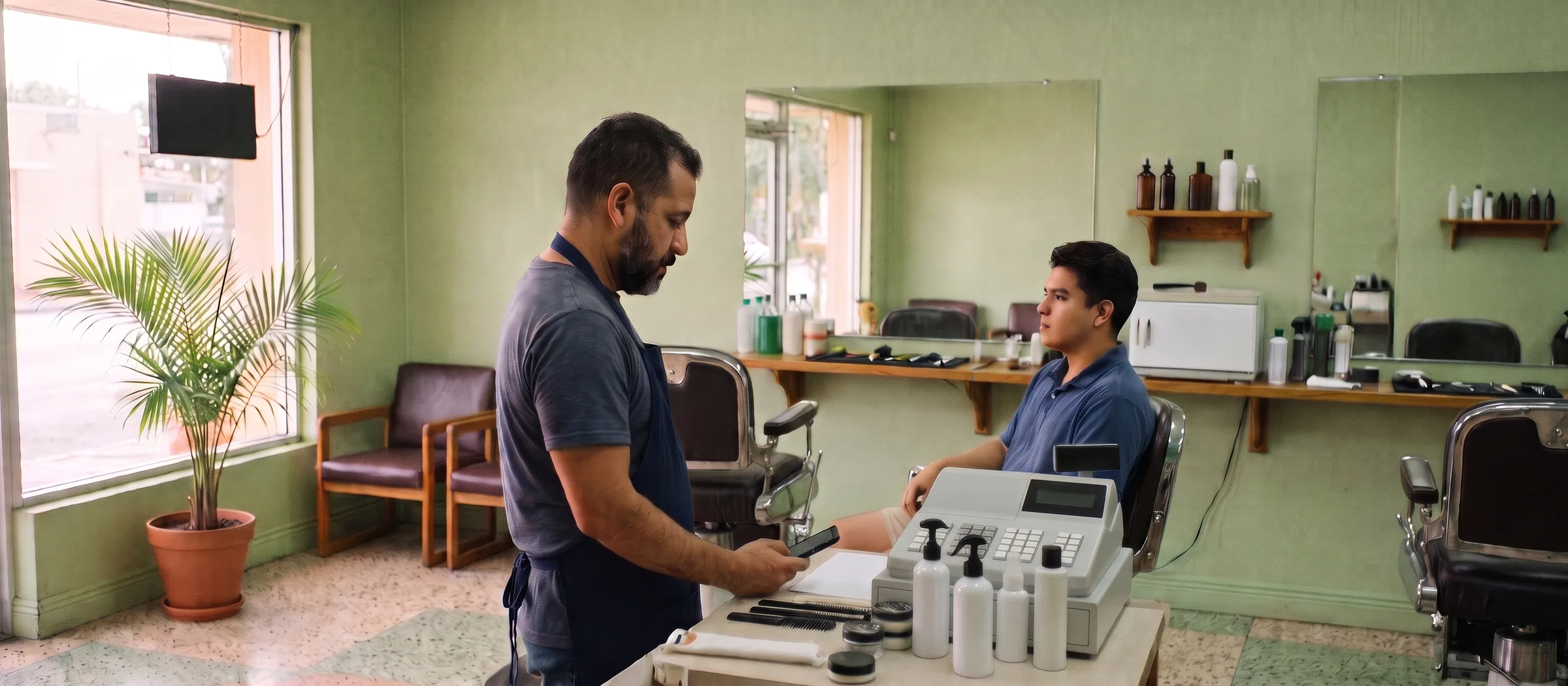
Short answer: For 30 kinds of local business, we compared one search in English with one in Spanish, such as “dentist near me” and “dentista cerca de mi”. In Miami-Dade, the Spanish search went from under 1% to 42% of the pair, depending on the trade, and never reached half.
In all 23 trades with enough searches to compare, the Spanish share was higher than in the country as a whole. For bakeries the gap was less than a point.
What we measured
In Miami-Dade, 67% of people aged five and over speak Spanish at home: 1,799,905 of 2,686,930, according to the Census Bureau. In the country as a whole the share is 13.9%. A local business needs a different figure: the language its customers type when they look for it on Google.
We took 30 trades and, for each one, a single pair of searches: “X near me” in English and “X cerca de mi” in Spanish. Google Keyword Planner gave us the average monthly searches of each one over the last 12 months, in Miami-Dade County and in the whole United States. The Spanish share is the Spanish search divided by the two searches together.
Sources: U.S. Census Bureau, American Community Survey 2024 1-year estimates, table C16001, released September 11, 2025. Google Keyword Planner, read November 1, 2026.
Spanish share of each pair, by trade
Shares are rounded to whole numbers, because Keyword Planner gives rounded estimates. Trades marked “low volume” have 30 Spanish searches a month or fewer in Miami-Dade in Keyword Planner's estimate, so a small change in that estimate moves their share a lot.
| Trade | Miami-Dade | United States |
|---|---|---|
| Pediatricians | 42% | 12% |
| Auto repair | 41% | 10% |
| Barbers | 31% | 14% |
| Immigration lawyers | 26% | 12% |
| Lawyers | 26% | 14% |
| Veterinarians | 23% | 7% |
| Accountants | 18% | 4% |
| Notaries | 17% | 3% |
| Pharmacies | 17% | 6% |
| Dentists | 14% | 5% |
| Hair salons | 14% | 5% |
| Accident lawyers (low volume) | 12% | 6% |
| Locksmiths | 11% | 2% |
| Optometrists | 10% | 1% |
| Car insurance (low volume) | 9% | 1% |
| Cleaning services (low volume) | 9% | 3% |
| Chiropractors | 8% | 3% |
| Gyms | 8% | 3% |
| Insurance agents (low volume) | 8% | 0% |
| Doctors | 7% | 1% |
| Daycare | 5% | 3% |
| Electricians | 5% | 1% |
| Movers | 5% | 1% |
| Plumbers | 5% | 1% |
| Restaurants | 5% | 1% |
| Real estate agents (low volume) | 4% | 0% |
| Bakeries | 3% | 3% |
| Nail salons | 2% | 0% |
| Tax preparers (low volume) | 2% | 0% |
| AC repair (low volume) | 0% | 0% |
Source: Google Keyword Planner, average monthly searches of the last 12 months, Google Search, all languages, read November 1, 2026. One pair of searches per trade, for example “dentist near me” and “dentista cerca de mi”. We read the same pairs in seven more US areas: Spanish searches by city.
What stands out
Spanish weighed the most for pediatricians, at 42%, and auto repair, at 41%. Barbers came next at 31%, then lawyers and immigration lawyers at 26% each, and veterinarians at 23%.
At the other end, Spanish was 2% for nail salons and tax preparers, 3% for bakeries and under 1% for AC repair, a low-volume trade.
In no trade did the Spanish search reach half of its pair. Even for pediatricians, almost 6 in 10 of the searches in the pair were in English.
Spanish still carries more weight here than in the rest of the country. Among the 23 trades with enough volume, the Miami-Dade share was higher than the national one in all of them: 17% against 6% for pharmacies, 23% against 7% for veterinarians and 14% against 5% for dentists. For bakeries the gap was under one point, and the seven low-volume trades are too small to compare.
What it means for a local business
The choice is rarely English or Spanish. It is how much of each, and the trade decides it. A pediatric practice in Miami-Dade that works only in English leaves out a large part of the people who look for it. A nail salon can put most of its effort in English.
Where the share is high, both languages belong where people find you: the Google Business Profile, the website and the ads. A profile has one name, but its posts and its replies can go out in both languages. Each review can be answered in the language it was written in. Write the Spanish pages for the people who search in Spanish, instead of copying the English ones word for word.
We apply these shares on our page about SEO in Miami, and our local SEO in Miami page covers the Google profile.
Method and limits
Each trade is measured with one pair of searches. “Near me” is only one of the ways people look for a business: others type the trade and the city, a neighborhood or the name of a business they already know. The shares describe that pair, not everything people search about a trade. We measured “cerca de mi” without the accent; other spellings and wordings were not part of the pair.
Keyword Planner gives estimates, rounded into ranges, and they change from month to month. That is why we show whole percents and don't rank trades that sit a point or two apart. The searches are Google Search only, without search partners. The area is Miami-Dade County as Google defines it, and the comparison is the whole United States.
We measured 31 trades and left out plastic surgeons: Keyword Planner returned no figure for the English search, so there was no share to compute. That leaves 30.
You can download the table as a CSV file, with the monthly searches behind each share.
Frequently asked questions
Are most “near me” searches in Miami-Dade in Spanish?
Not in the trades we measured. For each trade we compared “near me” in English with “cerca de mi” in Spanish. The Spanish search stayed under half of its pair in all 30, from under 1% for AC repair to 42% for pediatricians. At home it is different: the census says 67% of Miami-Dade residents aged five and over speak Spanish.
Which trades get the most Spanish searches in Miami-Dade?
In our comparison, pediatricians (42%) and auto repair (41%), followed by barbers (31%), lawyers and immigration lawyers (26% each) and veterinarians (23%). Each share comes from one pair of searches per trade, so it describes that pair, not every search about the trade.
Is Spanish more important in Miami than in the rest of the US?
Yes, in every trade with enough searches to compare, all 23. For pharmacies, for example, the Spanish share was 17% in Miami-Dade against 6% nationally. For bakeries the gap was under one point, and the low-volume trades are too small to compare.
Can I use these figures for my own business?
As a starting point. They come from Google Keyword Planner, which gives rounded estimates, and from one pair of searches per trade. Your customers may use other words, a city or a neighborhood. Keyword Planner is part of Google Ads, so you can check your own pair there.